
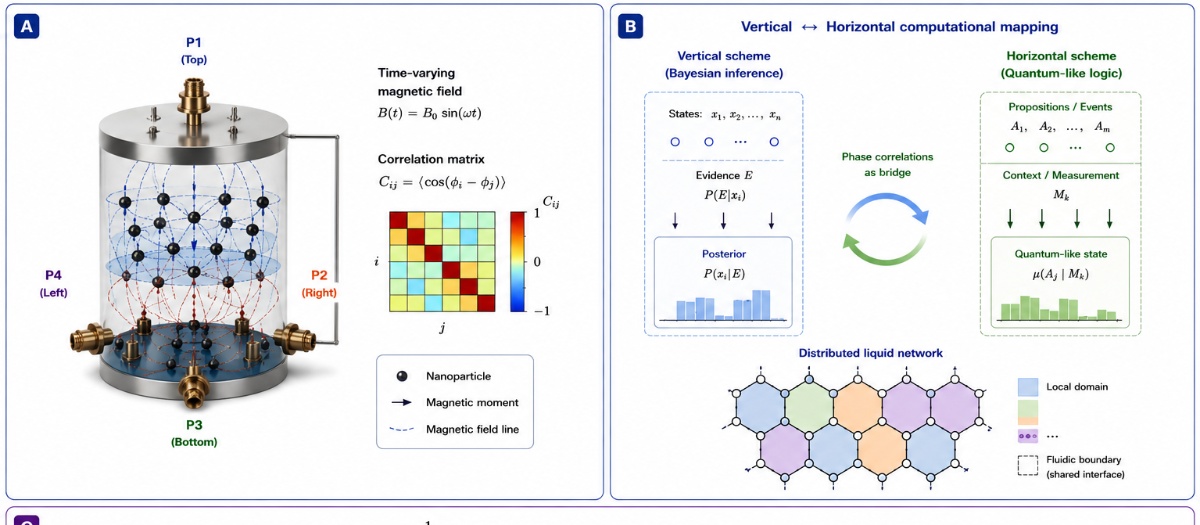
The realization of Physical Artificial Intelligence (PAI) requires a paradigm shift to address the energetic costs of extreme computation. Transitioning from rigid, silicon-based architectures to soft, adaptive, and topologically complex matter was recently addressed in our research. While conventional neuromorphic engineering relies on solid-state memristive crossbars, liquid computing exploits the intrinsic hydrodynamic and electrodynamic degrees of freedom of complex fluids to process information. This work introduces a computing platform powered by ferrofluids: water-based suspensions of superparamagnetic nanoparticles carrying both electric and magnetic dipoles. By modulating an electrical input, we alter the liquid's global energy landscape, measuring its impedance to generate an output stream. The colloid’s collective electrodynamic fluctuations and transient states can be mapped and decoded as high-dimensional informational states without classical computational bottlenecks. Our findings demonstrate that a liquid-state physical system can natively perform complex computing tasks through its inherent physical dynamics. Furthermore, we report the discovery of macroscopic quantum-like phase correlations between two physically and electromagnetically isolated volumes of this fluid. When a pre-conditioned "twinned" sample—subjected to specific magnetic hysteresis cycles—is split into separate, totally shielded containers, applying an electrical stimulus to one reservoir yields a remarkable, synchronized signature in the impedance fluctuations of the other. By linking colloidal coherence with algebraic structures that govern information routing, a radical, scalable route toward bioinspired PAI agents capable of low-power distributed computation and environmental adaptation is established.